
I used to think exercise meant pushing harder. This taught me that the bravest thing I could do was slow down.
Sarah
34 · practicing 11 weeks
Movement that meets you mid-spiral.
Slow, deliberate exercises paired with breathwork sequences — designed for the 2 a.m. chest-tighteners, the meeting-before-the-meeting pacers.
Start your anxiety audit↓Answer honestly. No one is watching.
These aren't diagnostic questions. They're the kind you ask yourself at 2 a.m. but never say out loud. Toggle yes or no for each one.
Do you hold tension in your jaw right now?
Did shallow breathing wake you up this week?
Are your shoulders closer to your ears than usual?
Does your stomach tighten before ordinary conversations?
Does resting feel like something you have to earn?
Do you find yourself gripping the steering wheel, phone, or coffee cup harder than necessary?
Does anxiety arrive before your alarm does?
Have you smiled through something this week that deserved a different response?
Each one targets a specific anxiety pathway.
Check the ones that resonate. At the bottom, you'll download exactly what you selected — nothing more.
Diaphragmatic Reset
Why it works
Slow diaphragmatic breathing directly activates the vagus nerve — the brake pedal of your nervous system. Within 90 seconds, heart rate variability improves and the prefrontal cortex regains control from the amygdala.
Lie on your back or sit upright. Place one hand on your chest, one on your belly. Breathe so only the lower hand rises. Inhale 4 counts, hold 2, exhale 6. Repeat for 5 minutes.
breathe
Shoulder & Neck Release
Why it works
The trapezius muscle chronically contracts during psychological stress. Releasing it sends proprioceptive signals that reduce cortisol production and tell the brain the threat has passed — even when it hasn't.
Sit in a chair. Drop your right ear toward your right shoulder. Breathe into the left side of your neck for 5 breaths. Slowly roll your chin to your chest, then to the left. Pause where you feel resistance.

Floor-to-Standing Grounding
Why it works
Changing your relationship to gravity — moving from floor to standing deliberately — interrupts the freeze response by engaging the vestibular system. It re-anchors your nervous system to the present moment.
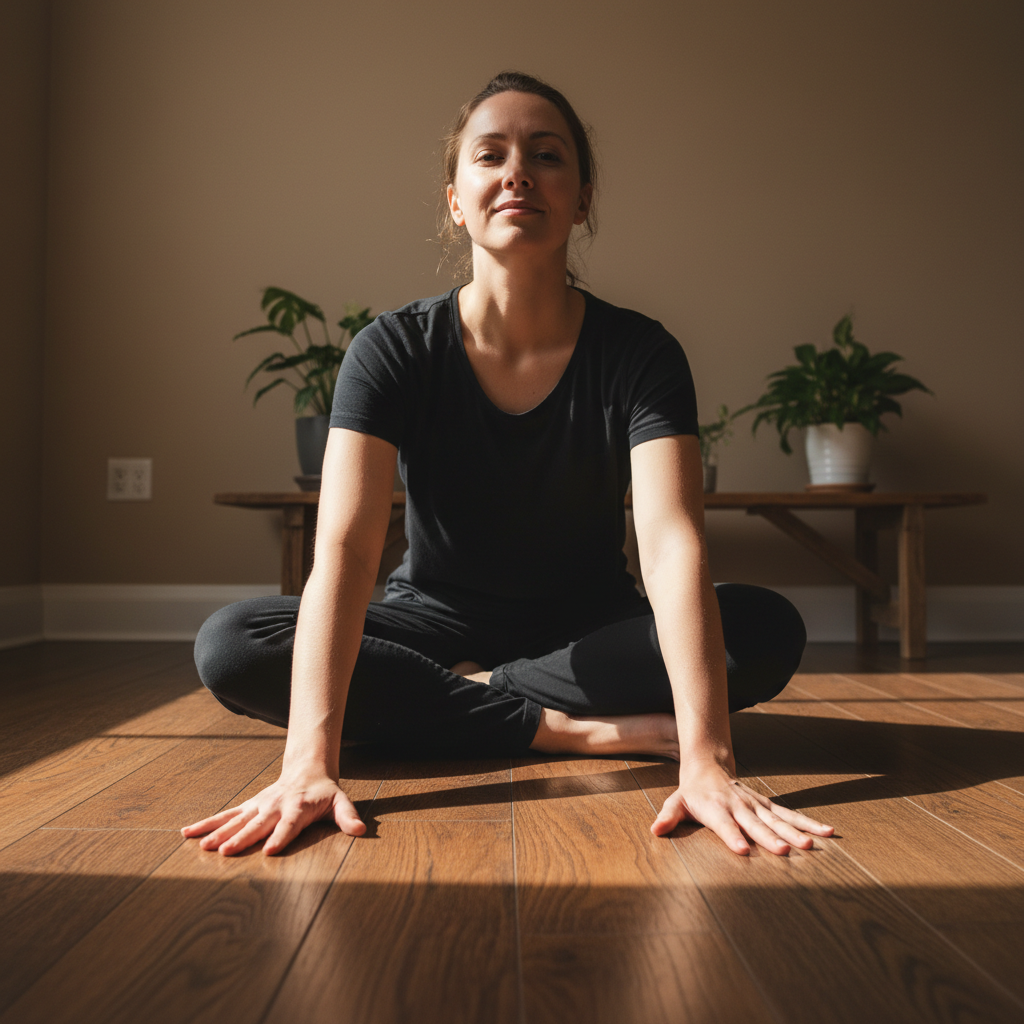
Sit cross-legged on the floor. Place your palms flat on the ground beside you. Feel the pressure. Breathe. Slowly rise to kneeling, then standing. Do this 5 times, narrating each position aloud if helpful.
Jaw & Face Softening
Why it works
The jaw is the body's primary tension reservoir. The masseter muscle connects directly to the trigeminal nerve, which modulates stress arousal. Releasing it signals safety to the brainstem faster than most other interventions.
Open your mouth wide and yawn — real or performed. Let your jaw hang. Place two fingers on your masseter (the muscle in front of your ears). Breathe in for 4 counts, and on the exhale let your jaw drop heavier.
breathe
Bilateral Walking Sequence
Why it works
Bilateral movement — alternating left-right body activation — mimics the eye movements used in EMDR therapy. It processes stuck emotional material by engaging both brain hemispheres simultaneously, reducing rumination within minutes.
Walk slowly, exaggerating the arm swing. Left arm forward with right leg. Count each step. At 10, pause for one full breath. Resume. The counting interrupts the thought loop; the movement processes what the counting can't reach.

People who found their exhale.
No before/after photos. No transformation arcs. Just honest accounts from people who showed up on hard days.
“I did the jaw release in my car before a board presentation. I walked in and my voice wasn't shaking for the first time in three years.”
Marcus, 41
practicing 6 weeks
“The audit was the first time I'd ever seen my anxiety written down in front of me without it feeling like a diagnosis. It just felt honest.”
Priya, 29
practicing 14 weeks
“I'm a night-shift nurse. I used to come home wired at 3am and lie there for hours. The bilateral walk is the only thing that actually transitions me.”
Danielle, 37
practicing 9 weeks
Download My Personal Routine
Every exercise you checked during your scroll becomes a page in your PDF — with instructions, timing, and the neurological reason it works. No email required.
Your routine includes
- ✓Step-by-step instructions for each exercise
- ✓Neurological explanation (plain language)
- ✓Suggested daily timing
- ✓A 4-week progression guide
Start the 7-Day Calm Reset
A guided video series delivered to your inbox — one session per day, 12 minutes each. Designed to systematically reduce baseline anxiety over one week.
You've already done the hard part — you showed up and answered honestly.